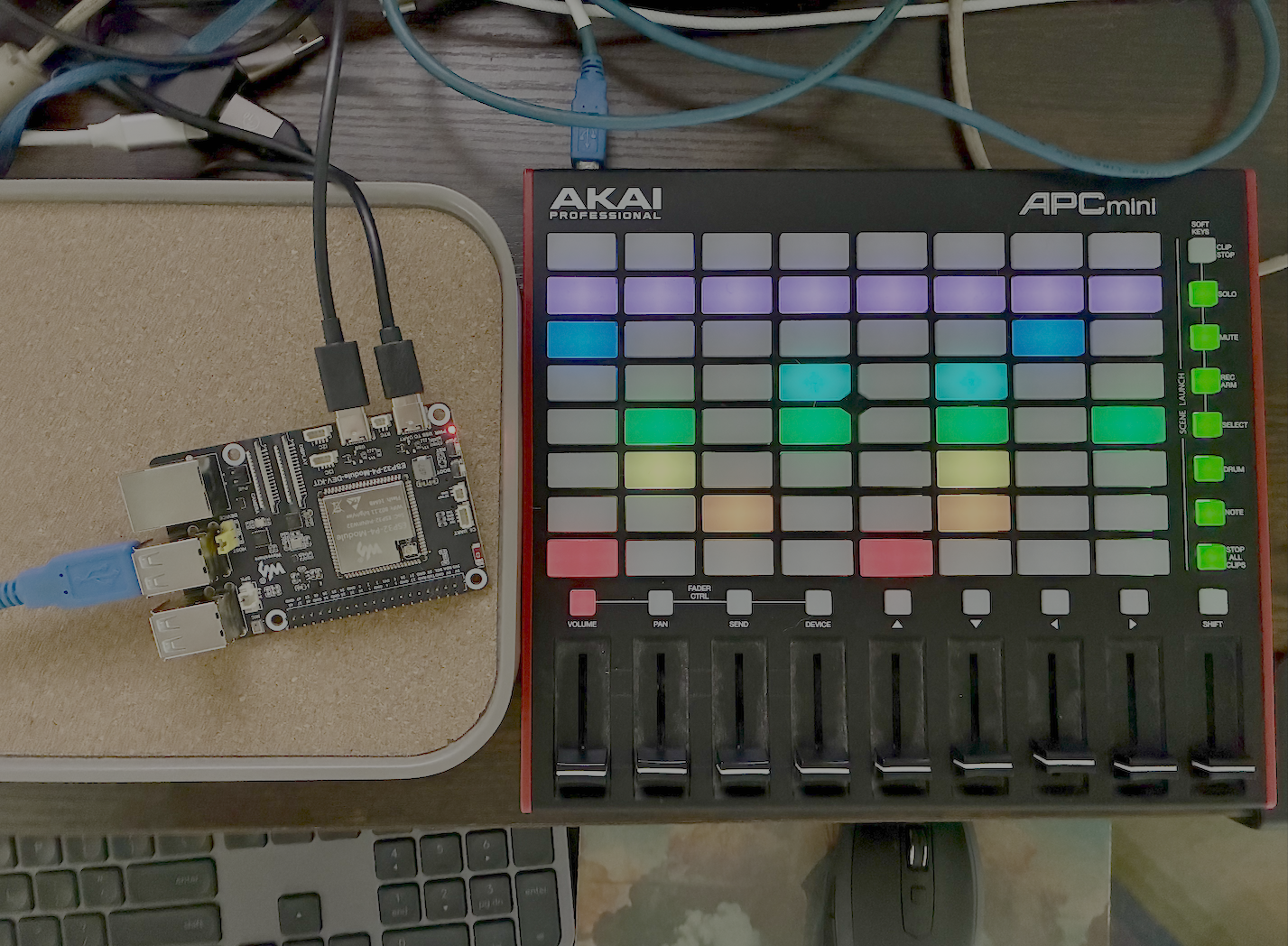
MiniStep ESP32-P4 is the hardware edition of MiniStep: an advanced step sequencer with a high-resolution master clock, persistent pattern memory, and direct USB-MIDI communication. The Waveshare ESP32-P4-Module-DEV-KIT uses the AKAI APC mini mk2 as its controller and appears to the computer as MIDISEQ Bridge.
Unlike the macOS Swift application, the sequencer engine runs on the microcontroller. It handles timing, pattern playback, chaining, fills, evolution, live performance, and live recording without requiring a computer to run the sequencer itself. The computer remains the sound destination for the generated MIDI for now. Future hardware plans include audio output, a screen with rotary encoders, and support for Novation devices.
Controller map
The APC mini mk2 remains the hands-on interface for the hardware edition. The diagram below shows the normal, Shift, Scene, parameter-editor, pattern-preview, and live-mode controls.
Hold Shift: scene mode
Sequencer
Grid toggle steps · Scene mute tracks · Pages select A–D
Play start / pause · Reset rewind · ↑ ↓ pattern preview
Shift
Shift + step step parameters · Shift + page chain pages
Shift + 7 / 8 tempo down / up · hold Shift for Scene mode
Scene mode
1 length · 2 rate · 3 direction · 4 Euclidean
5 evolve · 6 fill · 7 live performance · 8 live record
Step editor
Columns 1–4: velocity, probability, repeats, ratchet variation.
Columns 5–8: sample tuning · ↑ ↓ octave · Shift close
Pattern preview
↑ ↓ browse slots · Grid / pages edit without interrupting playback.
Play save and start / queue · Reset discard · hold ↑ + ↓ overview
Live modes
Performance: the grid triggers eight sounds while the sequence continues.
Record: bottom row records; other rows erase, mute, select, and edit steps.
What is implemented
- Eight tracks, 32 steps per track, across four hardware pages.
- 64 persistent pattern slots stored in the ESP32's internal flash.
- Pattern preview, queueing, overview, chaining, and MIDI Program Change.
- A shared high-resolution master clock with 20–300 BPM tempo control.
- Per-track lengths, rates, directions, Euclidean density, Evolve, and fills.
- Per-step velocity, probability, repeats, ratchet variation, and sample tuning.
- Live Performance and quantized Live Record modes.
- Track mutes that can be prepared while the transport is stopped.
- APC fader CC output for eight tracks and the master channel.
- USB-MIDI host input from the APC and class-compliant USB-MIDI output to the computer.
Connections
The APC connects to a USB-A expansion port on the Waveshare board. The board's
USB1.1 Type-C connector connects to the computer as MIDISEQ Bridge. The
separate CH343/UART Type-C connector is used for flashing and serial logs.
Keep the board's USB_SEL jumper on HOST.
Current status
This is an active hardware prototype. External clock synchronization, controller-profile configuration, JSON import/export, and SD-card workflows remain planned. The current build is designed around the APC mini mk2 and outputs MIDI 1.0.
For the macOS application edition, see MiniStep.